



Ok, interesting...
I’m at the desk in my office, jumping between tasks—per usual—when I come across a post on LinkedIn about how Substack just launched an AI detection feature.
Huh...
My eyes dart to the name of whoever posted it, then widen when I realize it's from the official Substack page. Um, ok... I lean forward, tucking my forearm under me to reread the text of the post. I'm slightly annoyed to be finding this out on LinkedIn rather than on Substack, but I click to read the full article anyway.
Substack partnered with Pangram to add “AI Detection” to the drop-down menu.
It can be used on both Notes and Articles/Posts, but only when at least 100 words.
Available now on web and iOS and will be coming to Android soon.
You can run Pangram on your drafts prior to publication.
Taking a minute to pause, I roll a small metal fidget between my left thumb and index finger. I want to think about this. Wind is rattling the trees beyond my windows and, occasionally, it’s slapping small leaves and twigs against the windows themselves.
By and large, I’m not sure if this is a good move on Substack’s part, but I’m also not convinced it isn’t. There’s absolutely been a rise in the amount of AI generated content on the platform, at least from what I’ve seen. People across the internet seem rather split on AI writing—some vehemently oppose it and check out immediately once they sense it, others are more laissez-faire and couldn’t care less so long as they enjoyed what they read.
As I’m turning the fidget over in my hand, I feel a layer of unease form in my stomach. Substack’s a writing platform. It’s designed so people who write can publish their work and distribute it to those who want to read it. The whole premise is that it’s free to use. BUT Substack has built-in features for writers to easily offer paid-tier subscriptions, and the way Substack makes money is by claiming a percentage of each and every transaction on the platform. Oh, and they make it so you must use Stripe, who also claims a percentage of transactions. That’s the whole business model.
I keep reading.
While scanning the info they provide, I land on the “how to” screenshots. Hmmph. Including those was actually a great move. So, I pull up Substack to try it. I don’t use AI on my stuff, but I just published an essay yesterday, and it’s at the top of my screen, so I click. I want to see what this feature looks like in action.
Annddd this whole thing takes a turn.
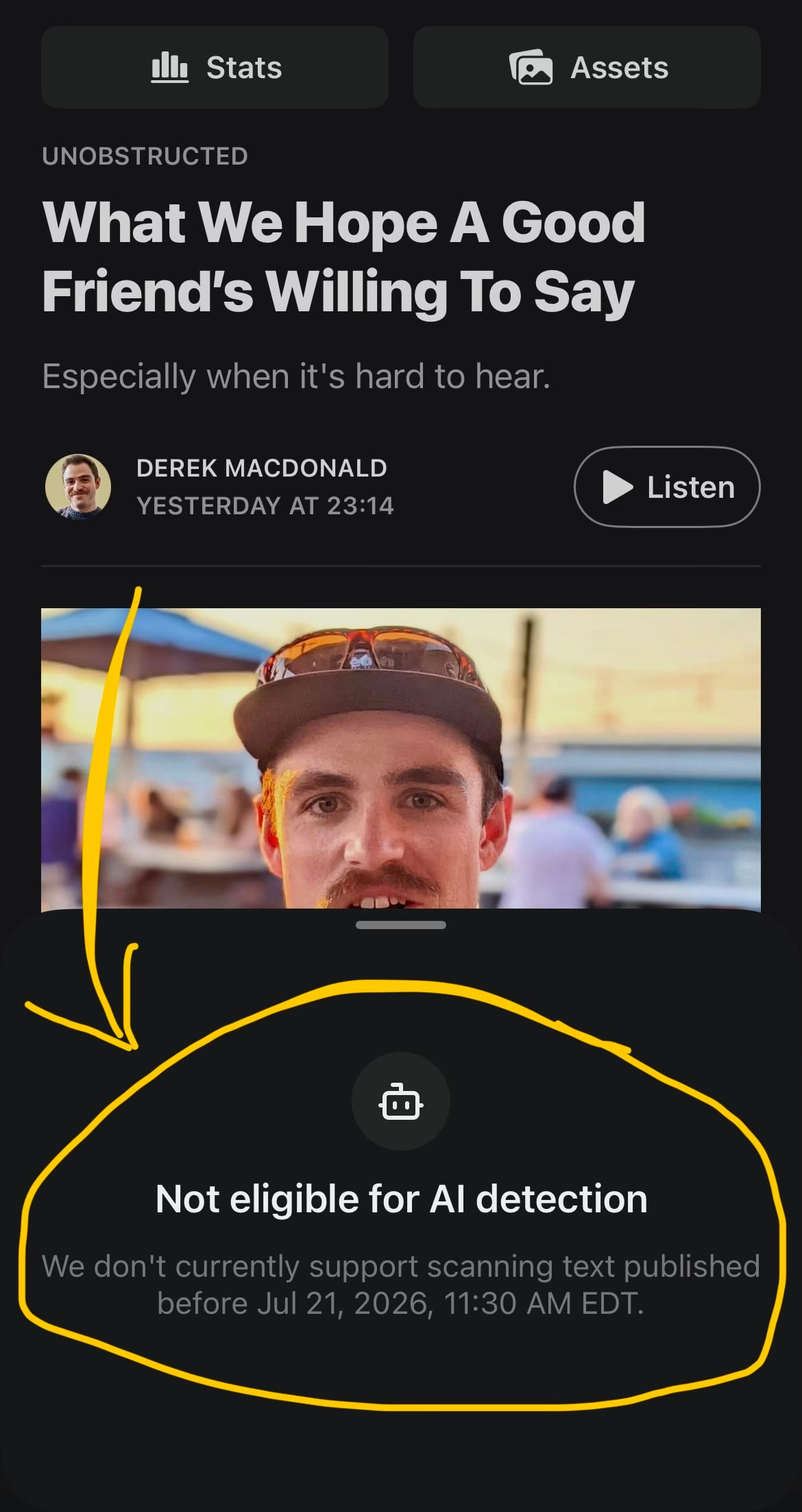
This AI Detection feature can only be used for stuff published after July 21, 2026 at 11:30am EDT.
I shake my head, lips pursed.
As of now, this new Substack partnership with Pangram is useless for verifying any existing content on the platform, so I have no idea if it's even any good. I can't use my own work to test it, let alone anyone else's. I'm wondering what will happen when people who pay for subscriptions start seeing stuff labeled as "AI generated" even if it isn't. That's been the problem thus far with AI detection software like this. Since the tech industry at large literally stole the work of every literary icon there ever was, it trained on the writing rules of the pros.
Based on what I’m reading, I’m nervous. The internet’s made clear that those of us who learned to write by using classic structures and literary devices are now at risk of being falsely accused as an AI fraud.
I crack a smirk.
Yes, I learned to write by (begrudgingly) following the rules. But then, somewhere along the way, I decided I'd graduated to where I could start breaking those rules; like a jazz player. And, these days, it feels like my style is uniquely mine. I guess I'm probably not the best person to judge how my writing comes across, though...
With a sigh, I slide away from my desk.
Time to face the storm and go for a walk.
***
To Substack’s credit, here are a few quotes that appear like they’re trying to preserve the space for everyone, regardless of technology preference:
“Pangram can only detect whether AI was used to make the text, not whether great human care went into creating it, nor whether AI tools were used as a source.”
“We’re not against people using AI to assist their work, and we think people should be free to choose which tools they use to express themselves.”
“But people should know what they’re getting.”
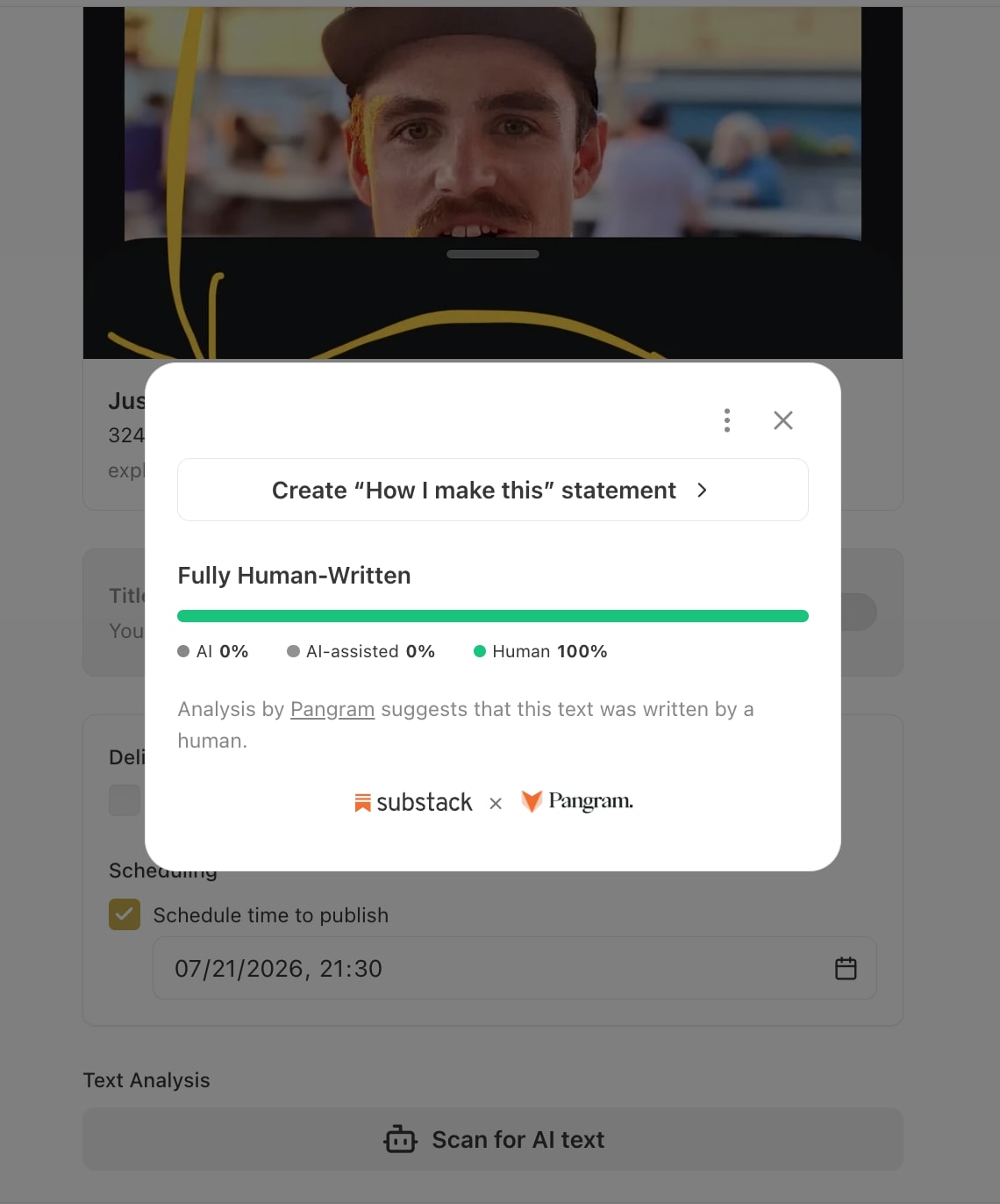
Editor’s Note: I tried testing the feature again using this piece instead, right before publishing, and here’s what the results look like.
Our Daily MAP Year Prompt
324/365
How do you feel about writers using AI?
onward.

For more on this daily column and The MAP Year Project, read the backstory.
Sign up to get it here.